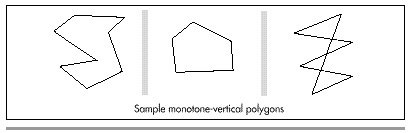
Figure 41.1 Monotone-vertical polygons.
| Previous | Table of Contents | Next |
Listings 41.2 and 41.3 are variants of the fast convex polygon fill code from Chapter 39, modified to be able to handle all monotone-vertical polygons, including nonsimple ones; the edge-scanning code (Listing 39.4 from Chapter 39) remains the same, and so is not shown again here.
Figure 41.1 Monotone-vertical polygons.
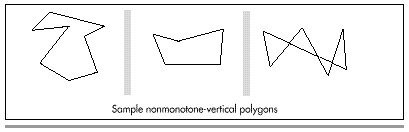
Figure 41.2 Non-monotone-vertical polygons.
LISTING 41.2 L41-2.C
/* Color-fills a convex polygon. All vertices are offset by (XOffset, YOffset).
“Convex” means “monotone with respect to a vertical line”; that is, every
horizontal line drawn through the polygon at any point would cross exactly two
active edges (neither horizontal lines nor zero-length edges count as active
edges; both are acceptable anywhere in the polygon). Right & left edges may
cross (polygons may be nonsimple). Polygons that are not convex according to
this definition won’t be drawn properly. (Yes, “convex” is a lousy name for
this type of polygon, but it’s convenient; use “monotone-vertical” if it makes
you happier!)
*******************************************************************
NOTE: the low-level drawing routine, DrawHorizontalLineList, must be able to
reverse the edges, if necessary to make the correct edge left edge. It must
also expect right edge to be specified in +1 format (the X coordinate is 1 past
highest coordinate to draw). In both respects, this differs from low-level
drawing routines presented in earlier columns; changes are necessary to make it
possible to draw nonsimple monotone-vertical polygons; that in turn makes it
possible to use Jim Kent’s test for monotone-vertical polygons.
*******************************************************************
Returns 1 for success, 0 if memory allocation failed */

#include <stdio.h>
#include <math.h>
#include <stdlib.h>
#include “polygon.h”

/* Advances the index by one vertex forward through the vertex list,
wrapping at the end of the list */
#define INDEX_FORWARD(Index) \
   Index = (Index + 1) % VertexList->Length;

/* Advances the index by one vertex backward through the vertex list,
wrapping at the start of the list */
#define INDEX_BACKWARD(Index) \
   Index = (Index - 1 + VertexList->Length) % VertexList->Length;

/* Advances the index by one vertex either forward or backward through
the vertex list, wrapping at either end of the list */
#define INDEX_MOVE(Index,Direction)                                  \
   if (Direction > 0)                                                \
      Index = (Index + 1) % VertexList->Length;                      \
   else                                                              \
      Index = (Index - 1 + VertexList->Length) % VertexList->Length;

extern void ScanEdge(int, int, int, int, int, int, struct HLine **);
extern void DrawHorizontalLineList(struct HLineList *, int);

int FillMonotoneVerticalPolygon(struct PointListHeader * VertexList,
      int Color, int XOffset, int YOffset)
{
   int i, MinIndex, MaxIndex, MinPoint_Y, MaxPoint_Y;
   int NextIndex, CurrentIndex, PreviousIndex;
   struct HLineList WorkingHLineList;
   struct HLine *EdgePointPtr;
   struct Point *VertexPtr;

   /* Point to the vertex list */
   VertexPtr = VertexList->PointPtr;

   /* Scan the list to find the top and bottom of the polygon */
   if (VertexList->Length == 0)
      return(1);  /* reject null polygons */
   MaxPoint_Y = MinPoint_Y = VertexPtr[MinIndex = MaxIndex = 0].Y;
   for (i = 1; i < VertexList->Length; i++) {
      if (VertexPtr[i].Y < MinPoint_Y)
         MinPoint_Y = VertexPtr[MinIndex = i].Y; /* new top */
      else if (VertexPtr[i].Y > MaxPoint_Y)
         MaxPoint_Y = VertexPtr[MaxIndex = i].Y; /* new bottom */
   }

   /* Set the # of scan lines in the polygon, skipping the bottom edge */
   if ((WorkingHLineList.Length = MaxPoint_Y - MinPoint_Y) <= 0)
      return(1);  /* there’s nothing to draw, so we’re done */
   WorkingHLineList.YStart = YOffset + MinPoint_Y;

   /* Get memory in which to store the line list we generate */
   if ((WorkingHLineList.HLinePtr =
         (struct HLine *) (malloc(sizeof(struct HLine) *
         WorkingHLineList.Length))) == NULL)
      return(0);  /* couldn’t get memory for the line list */

   /* Scan the first edge and store the boundary points in the list */
   /* Initial pointer for storing scan converted first-edge coords */
   EdgePointPtr = WorkingHLineList.HLinePtr;
   /* Start from the top of the first edge */
   PreviousIndex = CurrentIndex = MinIndex;
   /* Scan convert each line in the first edge from top to bottom */
   do {
      INDEX_BACKWARD(CurrentIndex);
      ScanEdge(VertexPtr[PreviousIndex].X + XOffset,
            VertexPtr[PreviousIndex].Y,
            VertexPtr[CurrentIndex].X + XOffset,
            VertexPtr[CurrentIndex].Y, 1, 0, &EdgePointPtr);
      PreviousIndex = CurrentIndex;
   } while (CurrentIndex != MaxIndex);

   /* Scan the second edge and store the boundary points in the list */
   EdgePointPtr = WorkingHLineList.HLinePtr;
   PreviousIndex = CurrentIndex = MinIndex;
   /* Scan convert the second edge, top to bottom */
   do {
      INDEX_FORWARD(CurrentIndex);
      ScanEdge(VertexPtr[PreviousIndex].X + XOffset,
            VertexPtr[PreviousIndex].Y,
            VertexPtr[CurrentIndex].X + XOffset,
            VertexPtr[CurrentIndex].Y, 0, 0, &EdgePointPtr);
      PreviousIndex = CurrentIndex;
   } while (CurrentIndex != MaxIndex);

   /* Draw the line list representing the scan converted polygon */
   DrawHorizontalLineList(&WorkingHLineList, Color);

   /* Release the line list’s memory and we’re successfully done */
   free(WorkingHLineList.HLinePtr);
   return(1);
}
| Previous | Table of Contents | Next |